




Read More
From a Latin American perspective EC(h)OTONING goes beyond transdisciplinarity, it is an exploratory extension of an ecotone. Whilst ecotones can be understood as zones of transition and tension between social, environmental and infrastructural systems, their conversion into a verb—as well as the play on the word ‘echo’—suggests a collective effort of extending the concept as knowledge-based resonances, as well as epistemologically unpacking it.
Rather than rendering fixed margins, ecotonar involves paying attention to the thick edges of the worlds: to the logics of coexistence of human and more-than-human, entanglements, transitions, conflicts, overlaps and transformations across the planetary surface. The Campus centred on exploring the verb ecotonar as a plurisensorial method for spatial studies of urban sustainability. With this in mind, the seminar ‘ecotonar: socio-environmental reverberations in Latin America' formed part of the preparatory process for the SMUS Regional Campus Latin America 2026, with 20 hours of an online seminar, for Master’s and PhD students. It concluded at the LATAM Campus, linking the discussions from the online sessions to the face-to-face activities.
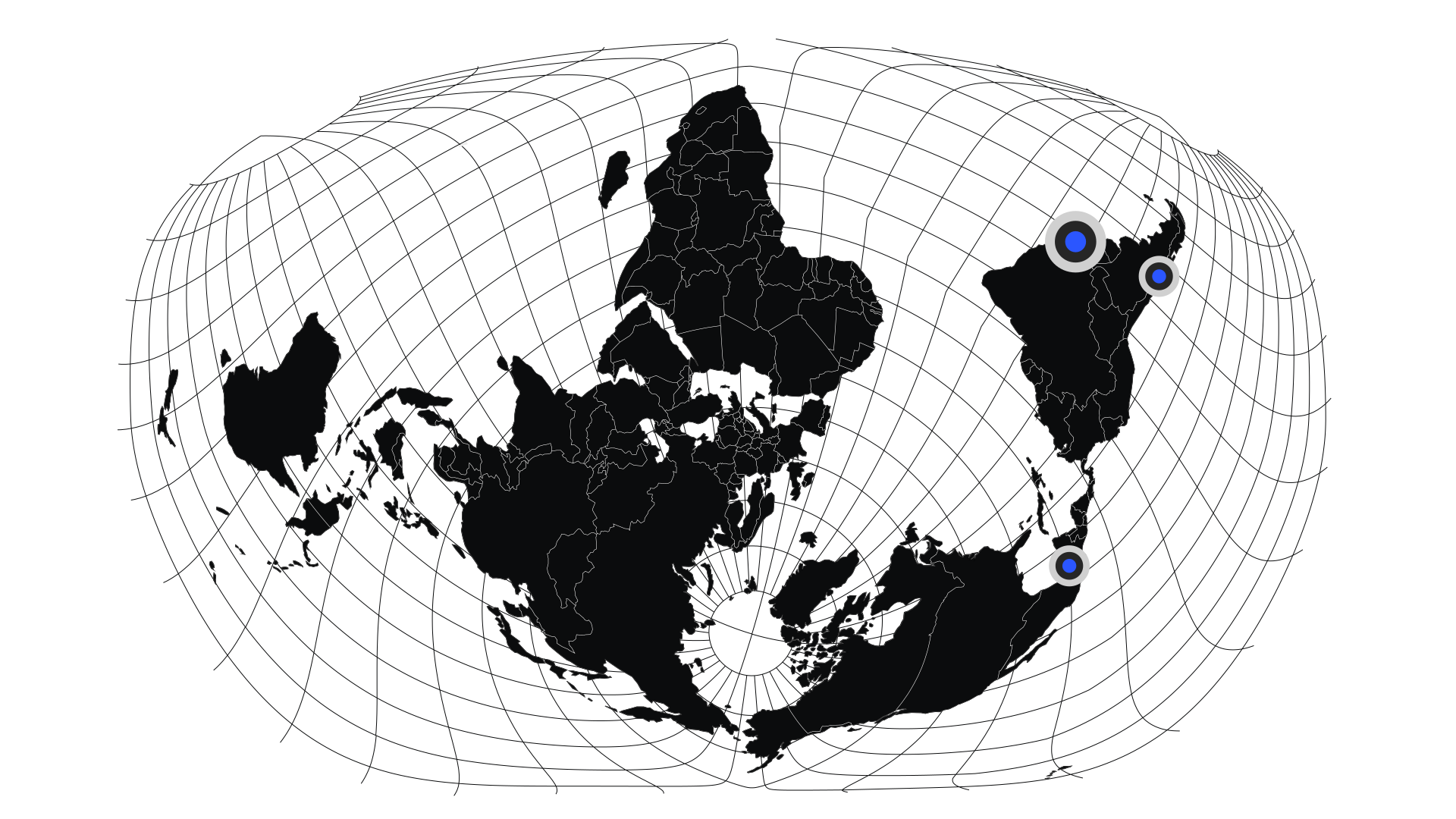
The online seminar aimed to collectively build conceptual and methodological foundations for the LATAM Campus, based on an exchange between the Latin American urban contexts, namely Mexico, Chile and southern Brazil. The Campus focused on interregional group exchanges with a common focus on three attributes that helped unwrap the concept of thick edges and the ecotonal approach: TRANSITIONS, between ecologies, cultures and knowledges; STAGNATION, archaeological agencies of residual systems and energy accumulations; and TEMPORALITY, as a geological, historical, and speculative time-based analysis. The course proved to be an opportunity to strengthen a common research agenda within the SMUS network.
Project Highlights
Participants
Inês Martina Lersch | Luciana Inês Gomes Miron
UFRGS | Scientific Leads
Clarice Misoczky de Oliveira | Andriele da Silva Panosso
UFRGS | Researchers
Ilana Boltvinik Riesenfeld
Universidad Veracruzana | Scientific Lead, SMUS RBA Curator
Rodrigo Viñas Miranda
TRES, México | Co-pilot, SMUS RBA Curator
Carolina Alejandra Rojas Quezada | Caroline Andrée Astrid Stamm
PUC Chile | Scientific Leads
Alexandre Kramatschek Tavares | Ana Lúcia Richter Dreyer | Isabelle Carolina Mongoni Soares
UFRGS | Student Participants
Beatriz von Saenger Hernández Tavares | José Alejandro Sánchez Vigil | Mariana Lagunez Ortiz
Universidad Veracruzana | Student Participants
Carolina Beatriz Jacob Reyes | Francisca Elizabeth Pimentel Fuentes | Gianna Salamanca
PUC Chile | Student Participants
Mariano Daniel Perelman
Universidad de Buenos Aires, Argentina | Campus Guest Lecturer
Raquel Weiss | Fernando Dornelles
UFRGS | Campus Guest Lecturers
Luana Pavan Detoni
Federal University of Pelotas, Brazil | Commentator
Andreas Brück | Felipe Vergara
TU Berlin, Germany | SMUS Sci-Com Coordinators
Jacqueline Jonsson | Cecília Giovenardi Esteves | Gianluca Mascali Perseu | Helena de Oliveira Ximendes | Bruno Henrique da Costa | Franciele Beck da Silva | Lucas Pinzon Brauwers
UFRGS | SMUS Campus Operational Team
Ana Lilian Brock de Souza | Bruna Ritter Brandenburger | Carolina Cristofoli Falcão | Diana Barquero Pérez | Graziele Demeneghi Martini | Helena Andrade Ew | Henrique Sanches Barboza de Oliveira | Jessica Tais Schoffen | Juliana Lombard Souza | Juliano Roques | Karolina Silva de Jesus | Lorena Costa Colares | Lucía Rodríguez | Luiza Tonial da Silveira | Marina Cristina dos Santos Brum | Martiele Wilhelm | Mônica Èmili de Camargo Fiori | Monique Thaís Vogel | Raul Gick Schumacher
Students attending the course 'ecotonar': socio-environmental reveverberations in Latin America
Visit the other Campuses
Read More
From a Latin American perspective EC(h)OTONING goes beyond transdisciplinarity, it is an exploratory extension of an ecotone. Whilst ecotones can be understood as zones of transition and tension between social, environmental and infrastructural systems, their conversion into a verb—as well as the play on the word ‘echo’—suggests a collective effort of extending the concept as knowledge-based resonances, as well as epistemologically unpacking it.
Rather than rendering fixed margins, ecotonar involves paying attention to the thick edges of the worlds: to the logics of coexistence of human and more-than-human, entanglements, transitions, conflicts, overlaps and transformations across the planetary surface. The Campus centred on exploring the verb ecotonar as a plurisensorial method for spatial studies of urban sustainability. With this in mind, the seminar ‘ecotonar: socio-environmental reverberations in Latin America' formed part of the preparatory process for the SMUS Regional Campus Latin America 2026, with 20 hours of an online seminar, for Master’s and PhD students. It concluded at the LATAM Campus, linking the discussions from the online sessions to the face-to-face activities.
The online seminar aimed to collectively build conceptual and methodological foundations for the LATAM Campus, based on an exchange between the Latin American urban contexts, namely Mexico, Chile and southern Brazil. The Campus focused on interregional group exchanges with a common focus on three attributes that helped unwrap the concept of thick edges and the ecotonal approach: TRANSITIONS, between ecologies, cultures and knowledges; STAGNATION, archaeological agencies of residual systems and energy accumulations; and TEMPORALITY, as a geological, historical, and speculative time-based analysis. The course proved to be an opportunity to strengthen a common research agenda within the SMUS network.
Project Highlights
Participants
Inês Martina Lersch | Luciana Inês Gomes Miron
UFRGS | Scientific Leads
Clarice Misoczky de Oliveira | Andriele da Silva Panosso
UFRGS | Researchers
Ilana Boltvinik Riesenfeld
Universidad Veracruzana | Scientific Lead, SMUS RBA Curator
Rodrigo Viñas Miranda
TRES, México | Co-pilot, SMUS RBA Curator
Carolina Alejandra Rojas Quezada | Caroline Andrée Astrid Stamm
PUC Chile | Scientific Leads
Alexandre Kramatschek Tavares | Ana Lúcia Richter Dreyer | Isabelle Carolina Mongoni Soares
UFRGS | Student Participants
Beatriz von Saenger Hernández Tavares | José Alejandro Sánchez Vigil | Mariana Lagunez Ortiz
Universidad Veracruzana | Student Participants
Carolina Beatriz Jacob Reyes | Francisca Elizabeth Pimentel Fuentes | Gianna Salamanca
PUC Chile | Student Participants
Mariano Daniel Perelman
Universidad de Buenos Aires, Argentina | Campus Guest Lecturer
Raquel Weiss | Fernando Dornelles
UFRGS | Campus Guest Lecturers
Luana Pavan Detoni
Federal University of Pelotas, Brazil | Commentator
Andreas Brück | Felipe Vergara
TU Berlin, Germany | SMUS Sci-Com Coordinators
Jacqueline Jonsson | Cecília Giovenardi Esteves | Gianluca Mascali Perseu | Helena de Oliveira Ximendes | Bruno Henrique da Costa | Franciele Beck da Silva | Lucas Pinzon Brauwers
UFRGS | SMUS Campus Operational Team
Ana Lilian Brock de Souza | Bruna Ritter Brandenburger | Carolina Cristofoli Falcão | Diana Barquero Pérez | Graziele Demeneghi Martini | Helena Andrade Ew | Henrique Sanches Barboza de Oliveira | Jessica Tais Schoffen | Juliana Lombard Souza | Juliano Roques | Karolina Silva de Jesus | Lorena Costa Colares | Lucía Rodríguez | Luiza Tonial da Silveira | Marina Cristina dos Santos Brum | Martiele Wilhelm | Mônica Èmili de Camargo Fiori | Monique Thaís Vogel | Raul Gick Schumacher
Students attending the course 'ecotonar': socio-environmental reveverberations in Latin America
Visit the other Campuses