




From a strictly ecological definition, ecotones are known as transitional areas between two distinct ecosystems or biomes, such as forest and river edge. They are places that function as interstices, a thick edge that serves as a contact zone of influence, exchange and negotiation, often associated with increased biodiversity and higher biomass density (Kahn & Burns 2021:201).
By applying the term to the urban realm and converting it into a verb EC(h)OTINING, we aim to extend this transitional area to one of mixed methodologies, in addition to different forms of knowledge and practice that foster an urban pluriverse.
Read More
From ecotones, we draw two key ideas. First, they act as spaces of uncommon assemblages, where fixed categories become blurred and mixed. Environments of coexistence between the more-than-human and their materialities. Second, they follow the notion of conceptual entanglements, zones of practicable interweaving.
The (h) in EC(h)OTONING reminds us about the constant echoes: connections and reverberations between human, more-than-human, and other material entities, between science and rituality, between past and future. EC(h)OTONING emphasises the ways environmental and urban processes reverberate across space and time. It highlights how interventions in one location often return elsewhere as unintended consequences, while drawing attention to the continuous adjustments through which humans and non-humans respond to changing conditions.
The (h) is also intended to encourage open dialogue that can be contagious and inspiring. In our project, the echo evokes multiple voices, beings, materialities, technologies, and a myriad of practices, absorbing, rippling, waving, and weaving together to generate subtle changes within the restless urban environments.
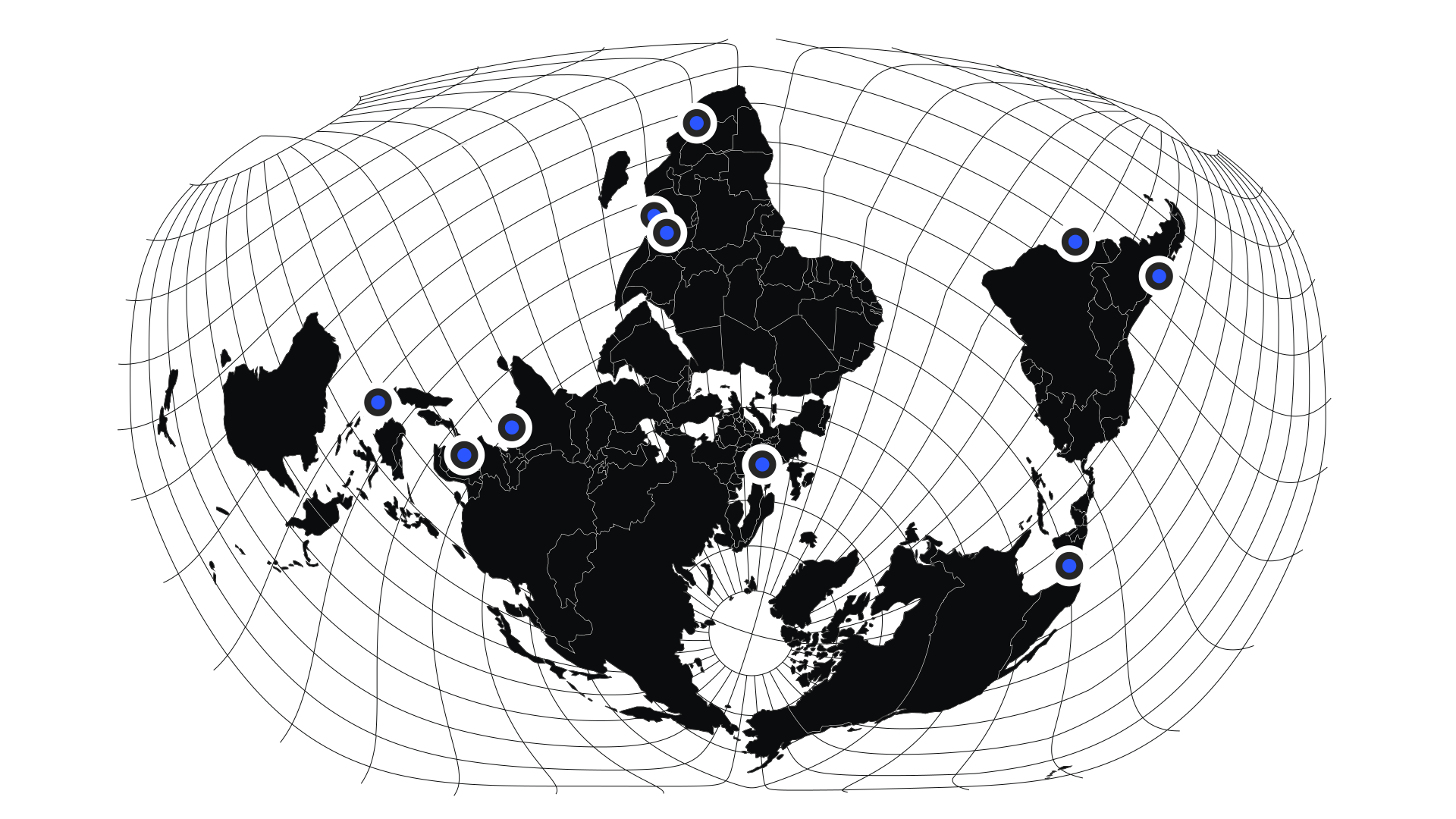
The Campus Series EC(h)OTONING the urban pluriverse is a project of the Global Center of Spatial Methods for Urban Sustainability (SMUS). The three-scales (city–region–transregional) Campus Series explores EC(h)OTONING as both an analythical and methodological proposition in and across 9 cities in 3 world regions—Latin America, East and Southern Africa, and South and Southeast Asia.
SMUS
SMUS is one of seven Excellence Centers for Exchange and Development (exceed), funded by the German Federal Ministry for Economic Cooperation and Development (BMZ) via the German Academic Exchange Service (DAAD). Its coordination unit is based at the Institute for Urban and Regional Planning (ISR) of the Technische Universität Berlin. As a global network of scholars and practitioners in the urban realm, SMUS serves as a platform facilitating dialogue and collaboration in urban sustainability research, teaching, and planning practice, addressing intertwined wicked urban problems (WUP).
Structure of the campus series
After preparing the grounds and hosting kick-off events in the nine core partner universities (2025), three Regional Campuses run in parallel in three progressive cycles (2026-2029), with the core partner universities alternating hosting roles. In the run-up to these Regional Campuses, each Core Partner integrates the Campus theme into student activities in their university (master class, workshop, excursion,…), after which a small delegation (scientific leads, co-pilots, and students) from each university travels to the regional host university to take part in the Campus, where they are joined by other regional experts. The Campuses itself are an intense mix of workshops, discussions, field visits, and joint exercises. At the end of each cycle, a Transregional Campus brings the discussions on a more international level, ensuring cross-pollination.
Each (Trans)Regional Campus produces one volume of the open access SMUS Campus book series EC(h)OTONING the urban pluriverse, which will be published by Berlin Universities Publishing.
Additionally, an International Lecture Series, a multi-phase Research-Based Art (RBA) programme, and Science Communication (Sci-Com) projects enrich the Campus Series.

Katleen De Flander
SMUS, TU Berlin | Campus series curator
Adriana-ACh Design
Campus series branding
visual intelligence
Website design
Periferia
Editorial design Campus book series
In May-June 2026, the 3 Regional Campuses took place in Nairobi, Bangkok, and Porto Alegre, developing a first regional take on EC(h)OTONING and thick edges. In April 2027, the Transregional Campus in Semarang will bring these discussions on a higher scale for cross-pollination, closing this first cycle. Please visit the Campuses below.