
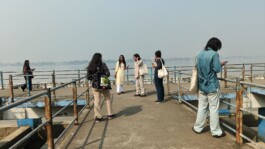




In the run-up to the Regional Campus Asia, the SMUS team at IIT Kharagpur held a kick-off event and prepared the grounds in Kolkata, India. Through undisciplined practices and methods, they focussed on reifying resilience for the amphibious urban spaces of ec(h)otonal Kol-kata.

flesh and bones of a city | photo by Megha Malakar, 2025
Kolkata has been reclaimed from a tidal swamp. The swaggering skyscrapers and swarming population of present-day Kolkata conveniently conceal her deltaic-estuarine-marshy-aqueous origins. There is an amnesia about the soaking ecologies of the Bengal Delta from where the city of Kolkata had been reclaimed (Bhattacharyya 2018). How to retrieve this history through collective memories of recovery? Beyond conventional cartographies and political history of infrastructure constructions, unravelling age-old memories ingrained in vernacular epistemologies and sedimented artefacts can bring back memories which have not been permanently destroyed but temporarily suppressed under the hubris of modernity. Why reclaim this erased past? Because it is in these deep-tangled histories of more-than-human enactments, the anecdote of origin, the account of functioning, and the apprehension of survival of this delta city are rooted. Ec(h)otonal Kol-kata is a replenishment attempt in this direction. It is a serrated reminder that top-down engineered resilience through capital-laden green and ‘blue’ investment plans will only serve a few for the time being, and at the cost of urban anthropocentric disasters looming large. It is also a solution-induced framework that envisions viability through “disruptive resilience,” building upon adaptive infrastructures “of” and “for” amphibious urban spaces.

messy ec(h)otonal assemblage | photo by Megha Malakar, 2025
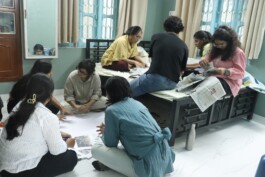
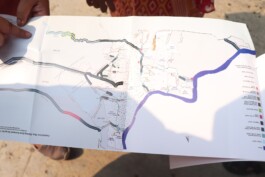
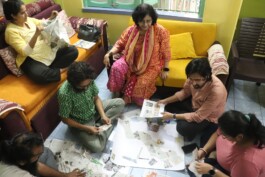
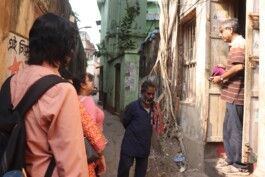
The SMUS Kolkata kick-off, organised through a collaborative-interactive workshop and outreach with a group of diverse stakeholders, marked the inception of this longer-term understanding and processes of sensing and documenting the city. The group experimented with undisciplined practices and methods such as sensory walks, sensory ethnography, self-reflexivity exercises, transect walks (deliberate movement to understand spatial relationships), storytelling, artifact collection, the creation of a curatorial box (challenging the colonial conservationist-archiving logic), co-curation through collage, and more.


immersive interactions | photo by Megha Malakar, 2025
the serpentine paths | photo by Megha Malakar, 2025
co-crafting a collage | photo by Megha Malakar, 2025
ethnographic exploration | photo by Megha Malakar, 2025
the essence of sensing collectively | photo by Megha Malakar, 2025
noun and verb combined: ec(h)otone as space, place, and method
Everything is an ec(h)otone! Boundaries are political demarcations that attempt to territorialise space with intent. Yet things exist as porous palimpsests—elements disappearing and reappearing in cyclical rhythms—imbricating far-reaching repercussions across space, time, and culture, simultaneously shaping and being shaped by change. Rigidity undermines resilience; it emerges from boxed thinking and bounded categories. We unsee what waits to be recognised, rushing to classify rather than dwell within entangled interactions and mutable interfaces. Such detached planning produces irreparable socio-ecological rifts. Moving beyond ecotones as mere transition zones, undisciplined modes of sensing reveal the power of embodied encounters to re-cognise processes and affects through which urban ecologies continually emerge as checkered assemblages of material and immaterial life.

connectibles | photo by Megha Malakar, 2025
cities as dense hybrids, necessitating ec(h)otonal probings
Urban ecology has seen a meteoric rise in scholarship from different perspectives: system-based approaches, political ecology, and, more recently, multisensorial, multispecies attuned environmental humanities. While there have been attempts to integrate them or “emphasise difference and diversity” (Gandy 2024a: 366), “…an alternative conceptual synthesis might allow for a more embodied, multi-subjectival, and historically situated reading of urban metabolism” (Gandy 2025) to do away with AI-enabled, fancy, investment-laden technocratic designs. But to arrive at multi-sensorial embodiments, empathising for cities as dense hybrids of intra-acting technologies, social configurations, and more-than-human agencies, towards an “engaged praxis,” deployment tactics are indispensable. There are no attempts to control and change existing urban environments through virtuous urban solutions, but unruly endeavours and experiments muddling subject, object, and agency in tracing the roots of wicked urban problems. EC(h)OTONING serves as a crucial intervention in methodological practice, assembling and contagioning empirics from nine different cities of the global South by demystifying detached observations and insisting on embodied subjectivities, forging deeper engagements, towards a desirable urban Anthropocene.
Bhattacharyya, D. (2018). Empire and ecology in the Bengal Delta: The making of Calcutta. Cambridge University Press.
Gandy, M. (2024). Four urban ecologies: A working typology and alternative conceptual synthesis. Progress in Environmental Geography 3(4): 352–374.
Gandy, M. (2025). Urban metabolism redux. Urban Studies.
output
exhibition SEW-AGE: walking the wastewater infrastructures of Kol-kata
participants
Agrima Mishra
IIT Kharagpur
Amitrajit Chakraborty
Disha
Amrita DasGupta
SOAS, UK
Ankush Geda
IIT Kharagpur
Anuradha Choudry
IIT Kharagpur
Jamie Allen
Science Gallery Bangalore
Jenia Mukherjee
IIT Kharagpur | Scientific Lead
Koustubh Chakrabarty
Jaladarsha
Megha Malakar
Veditum Foundation
Pinaki Gayen
Visva Bharati University
Pragya Tiwari
IIT Kharagpur
Priyadarshi Patnaik
IIT Kharagpur
Priyadarsini Sinha
IIT Kharagpur
Pratyasha Nath
TU Berlin
Raktima Ghosh
IIT Kharagpur
Sayontoni Datta
Jaladarsha
Shreyashi Bhattacharya
TISS, Mumbai
Siddharth Agarwal
Veditum Foundation
Souvik Das
Jaladarsha
Suchandra Bardhan
Jadavpur University
Sukrit Sen
Living Waters Museum